

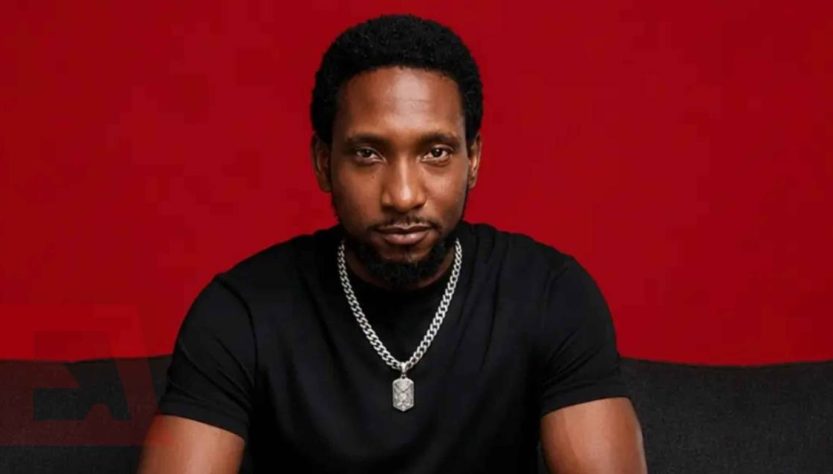
From his early experiences on the school stage to becoming an established face in Nollywood, actor and writer Seun Kentebe has built a career spanning television, theatre and film. His journey has seen him work across different creative disciplines, develop memorable characters and contribute to productions both on screen and behind the scenes.
Kentebe first gained wider recognition through the television sitcom Twilight Zone, a Cypress Associates production, before further establishing his writing credentials as the creator of Squatterz and one of the writers behind Saro the Musical.
In recent years, he has continued to explore different roles and creative opportunities, with appearances in projects such as A Danfo Christmas, Finding Balance and Caged Bird, the latter written and directed by Idiagi Ernest. He is also involved in the upcoming production Obafemi Hamzat: The Reformer.
In this conversation with Streamdorm, Kentebe reflects on his introduction to acting, the mentors who shaped his career, adapting to different directors, the growing influence of YouTube on Nollywood distribution, and what the industry needs to achieve sustainable global growth. He also discusses his upcoming projects and what audiences can expect next.
Streamdorm: What initially drew you to acting and storytelling, and were you nervous when working on your first project?
Seun Kentebe: I was basically drafted against my will. (laughs)
My first experience was in primary school at Santa Maria Private School, where I was ordered to play the lead in The Incorruptible Judge. I accepted so I wouldn’t get into trouble.
The second was at the University of Lagos (UNILAG), where I had to replace an actor in a play called Double Jeopardy, just a week before production! I was a nervous wreck, but KP (God rest his soul) and Abiola Aloba, who were the owners of Cypress Associates, gave me the much-needed motivation to see the character through.
Streamdorm: You’ve worked on several projects as an actor and writer, including short films and television productions. Looking back, what project do you consider your true breakthrough, and how did it affect your career? Is there any lesson that stuck with you from working on that project?
Seun Kentebe: My breakthrough was the TV sitcom Twilight Zone, a Cypress Associates production. It was my first shot at fame and, thankfully, I had great mentors in the persons of the above-mentioned KP (Kayode Peters, RIP) and Abiola Aloba.
Considering it was a transition from stage to TV, I learned early enough the ability to switch between both media: the larger-than-life approach for theatre and the toned-down approach for TV and film.
I also learned to stay humble, grounded and always find ways to stay relevant in the ever-dynamic Nollywood industry.
As a writer, being the creator of the hit sitcom Squatterz and one of the writers of Saro the Musical gave me yet another indelible platform. These days, it’s more acting than writing, but I do dabble from time to time.
Streamdorm: Having had the opportunity to work under multiple directors, adapting to different creative visions and expectations, how have those experiences shaped your approach to acting? Can you share a story about your favourite moment with a director that you still think about?
Seun Kentebe: It’s basically what I like to call “rolling with the punches.”
Each new director brings a new approach, but the common denominator is an actor who is prepared and also open-minded, as blocking and lines can change, and the actor is expected to deliver excellently.
One of my favourite moments was when I got a chance to work with a UK-based director who came to Nigeria to shoot a feature film. We followed each other on all social media platforms, but he said he’d never seen any of my works.
When we finally got to work, I was on set for one day. It was one scene, but the lines were lengthy. I had memorised them and was ready to go. He asked if I needed to have the script hidden, and I said, “No, thank you.”
After the first camera roll, he had a shocked expression, as he didn’t expect me to have all my lines in one take. Needless to say, there’s more projects lined up with bigger roles.
Streamdorm: You recently starred in Caged Bird, written and directed by Idiagi Ernest. Can you tell us what attracted you to the film and share your general experience while filming?
Seun Kentebe: I’m more of a surface sports fan, which is ironic as my late father was a one-time NFA chairman. But I saw it as a way of honouring him and also being the dual voice of reason and encouragement for a set of disillusioned individuals who believe their dreams are unattainable.
It was my first time working with Ernest, and my second with Korede. We played father and son in A Danfo Christmas.
Working with Ernest and the crew was an incredible experience. He is intentional without being pushy and isn’t afraid to let an actor run wild with the given material, as long as it aligns with his creative vision.
Streamdorm: Your recent feature-length film, Finding Balance, and short film, Caged Bird, are both available on YouTube for free. While YouTube offers creative freedom and a wider audience, do you think Nollywood is getting too comfortable with the platform, or would you want the industry to consider alternatives?
Seun Kentebe: At this point, YouTube is the holy grail for Nollywood filmmakers.
Considering the unfair sharing ratio cinema houses offer producers and the abrupt exit of Netflix and Prime Video, YouTube has provided a win-win situation. Your films are uploaded for free, and you get paid once you cross a particular threshold of watch hours.
Why fix what isn’t broken?
Streamdorm: While Nollywood has gained massive global recognition, it still faces distribution and funding challenges compared to other film industries. What is your message to investors, distributors and the global audience about what this industry needs to achieve its next level?
Seun Kentebe: I believe Nollywood is at a defining moment. We have moved beyond simply proving that African stories deserve a global audience; we are now at the stage where we must build an industry capable of financing, distributing and sustaining those stories on a global scale.
My advice to investors, distributors and the global audience would be this:
To investors: See Nollywood as a business with long-term potential, not just a creative venture. We need more structured investment, transparent financial systems, proper budgeting and sustainable funding models. Investors should be willing to support not only production but also development, post-production, marketing and distribution.
A great film without adequate promotion or access to the right audience may never recover its investment. We must also create room for emerging filmmakers with fresh ideas, rather than concentrating funding on only established names.
To distributors: Invest in access, not just acquisition. Nollywood needs stronger distribution networks, better cinema penetration, strategic streaming partnerships, international sales representation and improved marketing across different territories.
We must also strengthen intellectual property protection and ensure that filmmakers receive fair returns from their work. Distribution should not end when a film is released; it should be a deliberate strategy for reaching audiences and generating revenue across multiple platforms and markets.
To the global audience: Embrace Nollywood beyond curiosity about African culture. Watch our films, recommend them, discuss them, pay for legitimate access and give our stories the same openness you extend to films from Hollywood, Bollywood and other established industries.
Nollywood has stories that are deeply Nigerian and African, yet universal in their themes of love, ambition, family, identity, sacrifice and survival.
Ultimately, however, the responsibility also rests on us as industry practitioners.
We must continuously improve our storytelling, technical standards, professional ethics, production management and understanding of the global marketplace without losing the cultural authenticity that makes Nollywood unique.
Our next level will not be achieved by global recognition alone, but by building the structures that turn that recognition into sustainable revenue, stronger careers and lasting influence.
We have the stories, the talent and the audience. What we need now is the investment, infrastructure, collaboration and business discipline to match our creative potential.
Because the goal should not simply be for Nollywood to be watched by the world; it should be for Nollywood to become an industry in which the world is willing to consistently invest, partner and grow.
Streamdorm: You have Obafemi Hamzat: The Reformer currently in production. What should Streamdorm readers expect from the project, and what else can we look forward to?
Seun Kentebe: Ah, yes. Most people will think I collected APC money and have cross-carpeted, but that couldn’t be farther from the truth.
To me, it was simply a job: slipping into the skin of a character and delivering to the best of my ability. Plus, the producer and director who got me involved, Seun Oloketuyi and Tunde Played, respectively, are long-time collaborators who know my political leaning. But when business is brought to the fore, our political interests are left at home.
It was also my way of paying homage to late Alhaji Hamzat (RIP); he was a family friend and highly respected.
As regards other projects, I have a YouTube film and a stage play, Mentality, both slated for next month, and readings and rehearsals are ongoing. Plus, a couple of other projects that the respective NDAs won’t allow me to divulge.
I’ll definitely keep you updated.